Small Garden Design Ideas That Actually Make a Tiny Plot Feel Bigger
A designer's playbook for courtyards, side-returns and narrow plots: layout moves, planting strategy and the structural choices that make small gardens feel generous.

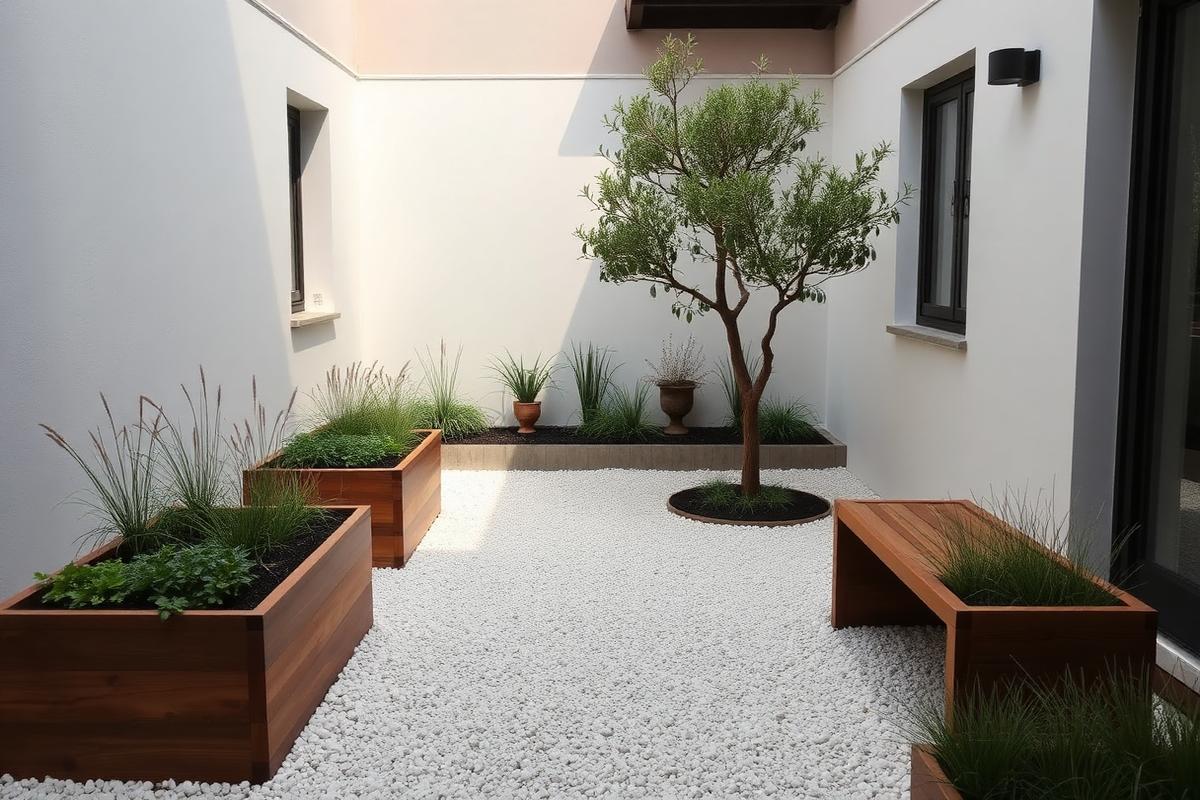
Small gardens reward design discipline. With less square footage, every decision is visible — the wrong paving stone or a misplaced pot reads instantly. The good news: the same constraint that makes small gardens hard also makes them faster to get right. Below are twelve moves I use on almost every small-garden project, drawn from twelve years of designing courtyards, side-returns and tight urban plots.
Why most small gardens fall flat
The most common mistake in a small garden is treating the perimeter as the design. Pots line the fence, a narrow strip of lawn fills the middle, and the eye is pulled straight to the back wall. The space feels exactly as small as it is.
Working designers do the opposite. They push planting into the centre, break the rectangle on the diagonal, and use a single strong feature to give the eye somewhere to land. A 30-square-metre garden treated this way can feel like 50.
Use the rule of thirds, not the perimeter
Divide the plot into three bands — entry, middle, and destination — and give each one a clear job. The entry is for transition; the middle for planting or a path; the destination for seating, a sculpture, or a single tree. Walking through three distinct zones makes a small garden feel like a journey rather than a single glance.
Commit to one hardscape material
Pick a single paving material — sawn sandstone, Belgian block, smooth concrete pavers — and use it for every horizontal surface. Mixed materials shrink a small garden. One material, used generously, expands it. If you need to break up the surface, do it with the planting, not the paving.
Plant in three vertical layers
A small garden needs ground cover, mid-height structure, and overhead canopy. Skip any one of these and the garden flattens. Even a 4×6m plot can hold a multi-stem amelanchier (canopy), a backbone of low evergreen shrubs (mid-height), and a carpet of geraniums or hardy ferns (ground cover).
Layering is also how you hide ugly fences without resorting to trellis. A canopy tree above eye level draws attention upward; the fence below disappears.
Choose exactly one focal point
Two focal points in a small garden cancel each other out. Choose one — a single specimen tree, a water bowl, a sculptural pot — and place it where the eye lands first from the most-used view (usually the kitchen window). Everything else supports it.
Lighting is half the design
Most small gardens are seen from inside the house, after dark, for half the year. Plan low-voltage uplights on your focal tree and one or two structures, plus a soft wash on a textured wall. Do not light the perimeter — it makes the garden look smaller. Light the centre and the canopy.
Key Takeaways
- Push planting and focal points into the centre, not the perimeter.
- One paving material, used generously, makes a small garden feel larger.
- Plant in three vertical layers: ground cover, mid-height structure, canopy.
- Pick exactly one focal point and design the rest of the garden to support it.
- Plan the lighting before you finalise the planting.
Frequently Asked Questions
What is the best layout for a small rectangular garden?
A diagonal layout almost always reads larger than a straight axial one. Run a path or planting bed at roughly 30–45 degrees to the boundary; the eye travels further and the rectangle disappears.
Should a small garden have a lawn?
Below about 25 square metres a lawn is usually more maintenance than reward. Replace it with low ground-cover planting, gravel, or a single generous paved terrace.
How many plants do I need for a small garden?
Fewer varieties, more of each. Aim for five to seven plant species used in repeated groups of three to five, rather than 20 single specimens.