Modern Driveway Landscape Design: Approaches, Materials and the Details That Make an Arrival Feel Considered
The driveway is the first and last thing anyone sees of your home. Here is how modern driveway design uses paving, planted strips and lighting to turn arriving home into an experience.

The driveway is the first and last thing anyone sees of your home. Almost everywhere, it also occupies more square footage than any other outdoor surface — which makes it the single biggest opportunity to change how the whole property reads. Designing a modern driveway is about turning a car park into a sequence.
Design the arrival, not the parking spot
A good driveway has a start, a middle and an end. The start is the entrance — a gate, a change of paving, a pair of trees. The middle is the approach — a long clean surface, ideally with a slight curve or level change so the house is revealed gradually. The end is the parking area — the smallest possible surface for the cars, sitting off the main axis.
Most poor driveways omit the middle entirely, so the car parks two metres from the front door and the house presents to guests as a garage.
Modern paving materials and permeability
Large-format concrete or porcelain slabs, resin-bound gravel, or clay setts are the go-to modern surfaces. Herringbone brick reads traditional; asphalt reads utilitarian; block paving with contrasting borders reads suburban 1990s.
Permeability is now a real requirement in many jurisdictions. Resin-bound gravel and permeable jointed paving both satisfy planning rules and drain heavy rain without flooding.
Planted strips and green joints
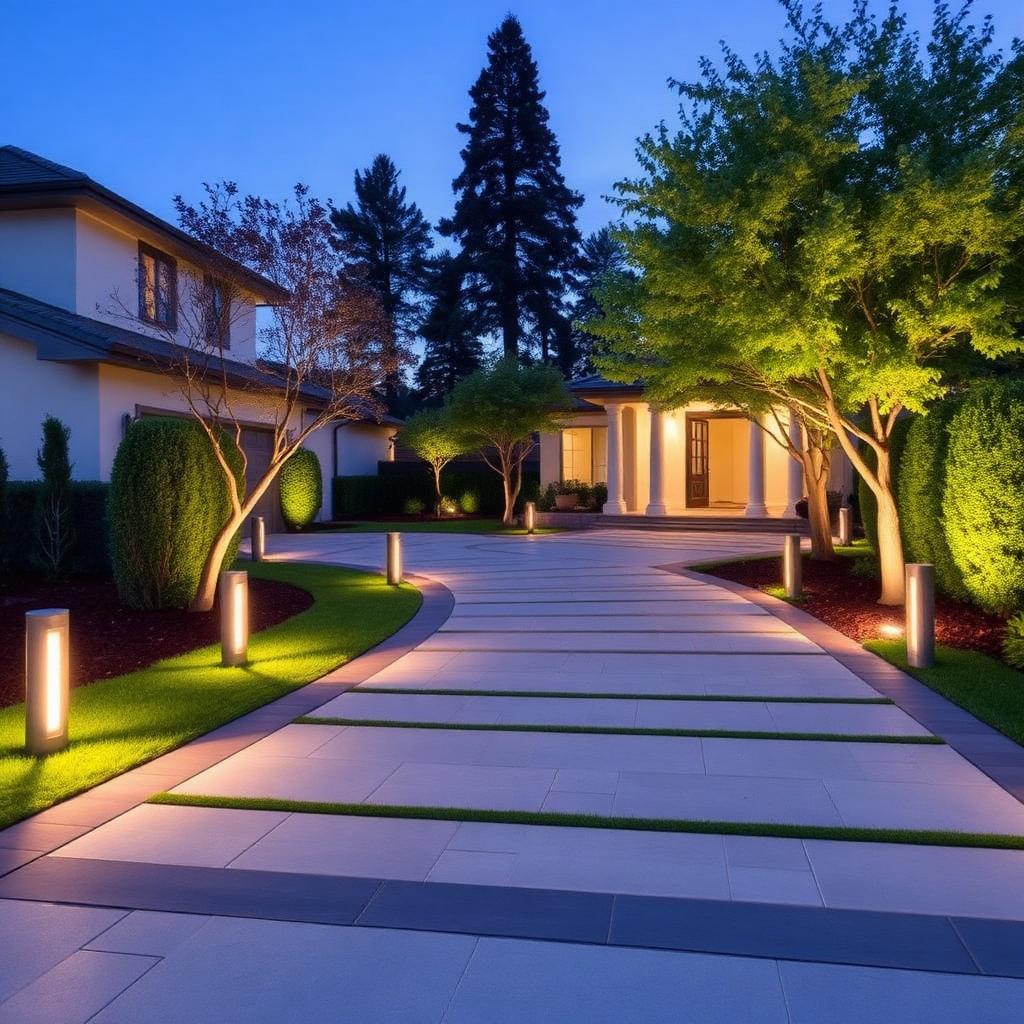
Two strips of hard paving with a central green ribbon (mondo grass, thyme, Sesleria) reads as architectural and cuts the visible hardscape by a third. On wider drives, repeat the same green ribbon on the outer edges as a soft border.
For a stronger modern statement, break the driveway into large paved rectangles separated by 300–500mm planted joints filled with structural grasses. The eye reads paving and planting as one composition rather than a slab of pavement.
Bollards, uplights and washes
Bollard lights along the length of the drive are the safest and most elegant option — 600–900mm tall, 3–4m spacing, warm 2700K. Skip pathway spikes and low mushroom fittings; both date immediately.
Uplight one specimen tree at the entrance and one at the arrival to bracket the arrival sequence. On the house face, a soft wall wash beats spotlights on architectural features.
Edges and drainage
The driveway edge is where good drives fail visually. Use a flush stone kerb, a slot drain, or a hidden concrete edge beam — never mortared random-stone edging or plastic edging with pegs.
Cross fall 1:60 minimum to a slot drain or a swale, never to the front door. Standing water at the arrival is the single most persistent design failure in residential driveways.
Key Takeaways
- Design a start, middle and end — a car park at the front door is not an arrival.
- Large-format slabs, resin gravel or clay setts; permeable where possible.
- Central or outer planted ribbons cut visible hardscape by a third.
- Warm bollards along the length; uplit trees at the entrance and arrival.
- Flush kerbs and slot drains at the edges; never plastic edging.
Frequently Asked Questions
Do I need permission to change my driveway?
In the UK, permeable surfaces or drainage-controlled drives typically do not need planning permission; impermeable surfaces above 5m² draining onto the highway do. In the US, most residential driveway replacements need only permits, not zoning approval.
How wide should a modern driveway be?
Single-car access 3.0m, plus 300mm each side for verges. Two-car parking side by side 5.5m. Turning bays need 6.0m radius minimum.
How much does a modern driveway cost?
In 2026, expect £180–£350 per m² for large-format porcelain, £120–£220 per m² for resin-bound gravel, and £250–£450 per m² for hand-set clay setts, all in the UK. US pricing scales roughly similarly per square foot.