Modern Concrete Patio Ideas: Large-Format Slabs, Joint Patterns and Integrated Planting
Concrete is the default modern paving because, done well, it disappears. Here is how large-format slabs, joint patterns and integrated planting produce a patio that reads as one considered plane.

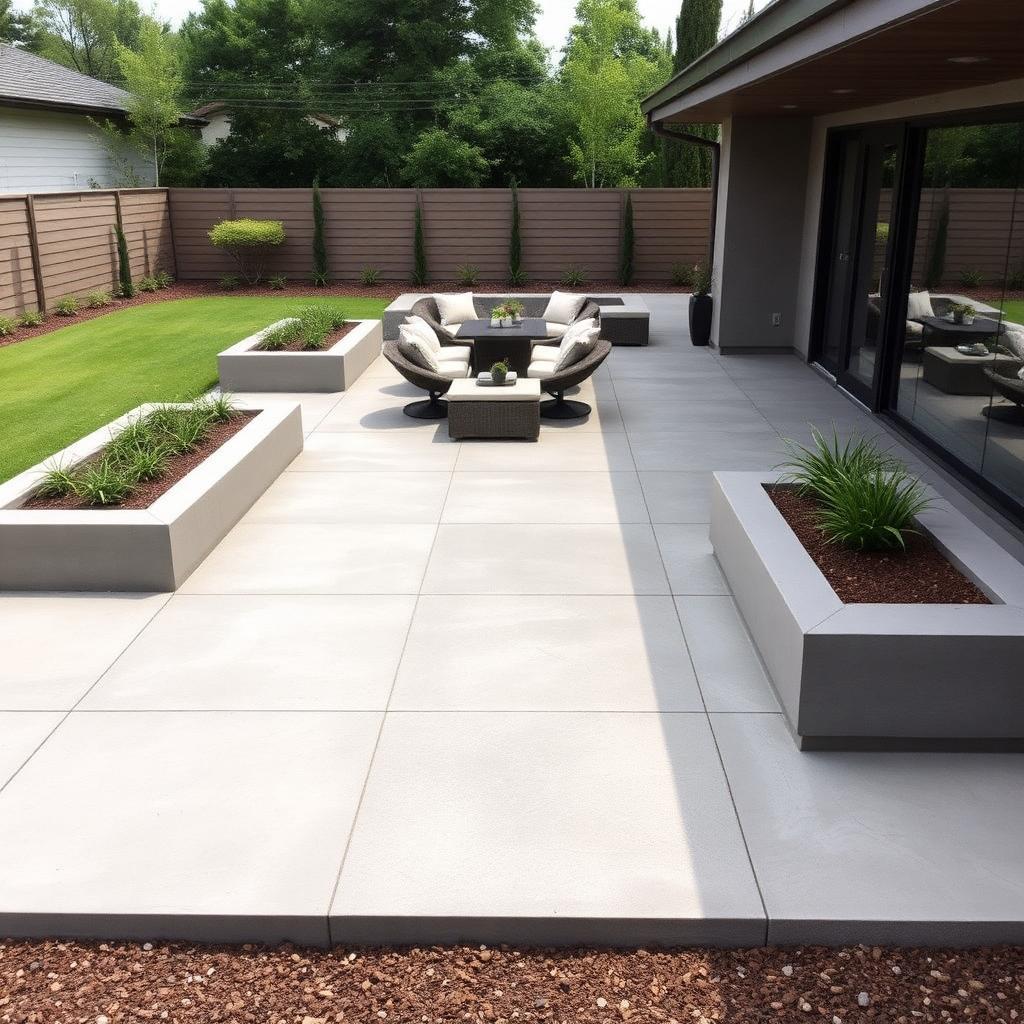
Concrete is the default modern paving for a reason — done well, it disappears, leaving the planting, the furniture and the architecture to do the visual work. Done badly, it cracks, stains, and looks like a car park. The difference is entirely in the specification.
Poured slabs vs precast slabs
Poured in-situ concrete: seamless, custom-shaped, but prone to shrinkage cracks unless properly jointed. Best for large open plates where the visual continuity is worth the technical care.
Precast concrete slabs (600×600mm, 800×400mm, 1200×600mm): predictable, factory-finished, and easier to lift for services or repairs. On most residential patios, large-format precast wins on cost and reliability.
Format, joint patterns and grid alignment
Bigger slabs read as more expensive. Standard 600×600mm reads as garden centre; 800×800mm or 1200×600mm reads as designed. Anything larger than 1200mm needs a rigid bed and edge restraint.
Joint pattern: stack bond (aligned grid) reads as modern; running bond reads as traditional. Align the grid with the architecture — a slab joint that meets a doorway centre or a wall face reads as intentional; one that lands 130mm off looks accidental.
Finish, colour and slip resistance
Finish: sawn, honed or lightly bush-hammered. Polished concrete is inappropriate outdoors — it is dangerous when wet and looks wrong in daylight. Trowelled finishes on poured slabs should be soft, not shiny.
Colour: greys ranging from warm oatmeal to charcoal. Off-white is punishing on a large area and will show every leaf stain. Slip resistance: aim for R11 minimum on any area that will get wet.
Integrated planting
The single move that keeps a large concrete patio from feeling like a car park is a planted joint — a 300mm-wide strip of ground cover (mondo grass, Sesleria, thyme) between slabs at deliberate intervals. It breaks the plane, softens the reflection, and gives the paving a scale.
For a stronger statement, sink a linear planter flush with the paving and fill with a single species. The effect is a green line drawn across the terrace.
Drainage and clean edges
Fall: 1:80 minimum, away from the house. Combine with a slot drain along the low edge — visible spot gullies wreck a modern patio.
Edges: no visible haunch of concrete around the perimeter. Set the slab against a hidden concrete edge beam, so the paving appears to end in a clean line against the planting or gravel.
Key Takeaways
- Large-format precast (800×800mm+) beats small slabs on almost every modern patio.
- Stack-bond joints aligned with the architecture read as intentional.
- Sawn or honed finish; greys from oatmeal to charcoal; R11 slip minimum.
- One or two planted joints or a flush linear planter breaks the plane.
- Slot drainage and hidden edge beams; no visible gullies or haunching.
Frequently Asked Questions
Does poured concrete always crack?
It will always develop micro-cracking; control joints hide it. Properly sawn control joints at 3–4m intervals in both directions keep cracking to those joint lines rather than randomly across the slab.
Can I lay large-format slabs myself?
Small formats yes; 800mm+ slabs are heavy (often 60–120kg each) and need proper lifting equipment, a stable rigid bed and correct edge restraint. Professional installation is strongly recommended above 600mm.
How do I stop concrete staining?
Seal with a matt penetrating sealer on installation and re-seal every 3–5 years. Clean up oil, wine and leaf tannins quickly; even sealed concrete stains if spills are left to sit.