Japanese Garden Design Principles: The Seven Ideas Behind Every Great Zen Garden
Most 'Japanese-style' Western gardens get it wrong. Here are the seven principles behind authentic Japanese garden design — and how to apply them honestly in your own space.

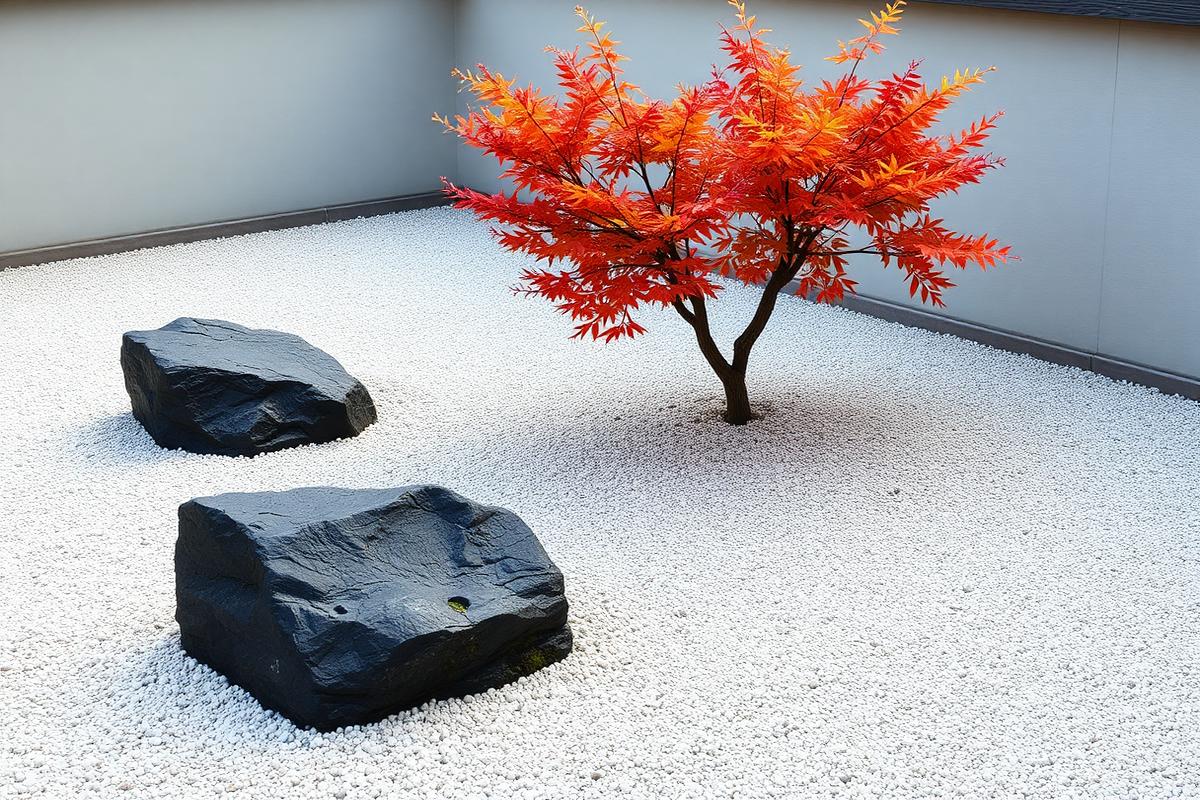
A real Japanese garden is not a stone lantern next to a bamboo screen. It is a design tradition fifteen hundred years old, built on a small number of deeply considered principles. Understanding them is the difference between a garden that gestures vaguely east and one that actually works.
The three garden traditions
Most authentic Japanese gardens fall into one of three traditions: the karesansui or dry stone garden (the famous raked gravel and rock compositions of Kyoto temples), the chaniwa or tea garden (a deliberately rustic path leading to a tea house), and the tsukiyama or stroll garden (a larger landscape with ponds, bridges and viewing points). Each has its own rules. Mixing them carelessly is the most common mistake in Western imitations.
Asymmetry over symmetry
Japanese design avoids exact balance. Stones are grouped in odd numbers — three, five, seven — and arranged in irregular triangles. A perfectly symmetrical layout reads as static and lifeless in this tradition.
Shakkei: borrowed scenery
Shakkei means deliberately framing a view of something outside the garden — a distant mountain, a temple roof, an old tree in a neighbour's garden — and treating it as part of the composition. In a Western context this might be a church spire, a mature oak two gardens over, or a glimpse of the horizon.
Ma: the value of empty space
Ma is the negative space between objects. A Japanese garden uses gravel, moss or water to create deliberate pauses between planted areas. The empty space is not absence — it is the thing that lets the eye and mind rest, and gives the planted elements weight.
Miegakure: hide and reveal
A good Japanese garden is never entirely visible at once. A bend in the path, a screening shrub, or a change in level hides part of the view so that walking through the garden becomes a sequence of small discoveries.
Stone, water and the cosmos
Stones represent permanence and the body of the earth; water represents impermanence and movement. A traditional karesansui uses raked gravel as a stand-in for water — the rake patterns suggest current around the islands of stone. Choose stones with character (weathered, lichen-covered, irregular) and set them deep enough to look as if they have always been there.
Applying these principles in a Western garden
You do not need a temple budget. A small Japanese-influenced corner can work in any garden: a single multi-stem Acer palmatum, three weathered stones in an asymmetric triangle, a ground cover of moss or Soleirolia, and a quiet bench positioned to frame a borrowed view. Avoid plastic lanterns, dyed gravel, and red lacquered bridges — they read as costume, not design.
Key Takeaways
- Japanese gardens belong to three distinct traditions — don't mix them carelessly.
- Use odd-numbered, asymmetric stone groupings.
- Borrow a view from beyond your boundary whenever possible.
- Treat empty space (ma) as a designed element, not leftover.
- Avoid costume-shop ornaments; let stone, water and a few good plants do the work.
Frequently Asked Questions
What plants are used in a Japanese garden?
Common choices include Japanese maple (Acer palmatum), pine (especially Pinus mugo or P. parviflora), azalea, moss, ferns, bamboo (clumping varieties only), and ground covers like Ophiopogon or Soleirolia.
Do I need a pond for a Japanese garden?
No. The karesansui or dry garden tradition uses raked gravel to represent water and is well-suited to small Western gardens with no plumbing.
How big does a Japanese garden need to be?
Some of the most famous examples (Ryōan-ji's stone garden, for instance) are smaller than a typical suburban back garden. A 3×4m corner is more than enough to apply the principles honestly.