Infinity Pool Backyard Design: What It Costs, Where It Works, and How to Site It Properly
An infinity edge only reads as one from specific viewpoints, on the right slope, at the right height. Here is how designers site them — and where a straight pool would look better.

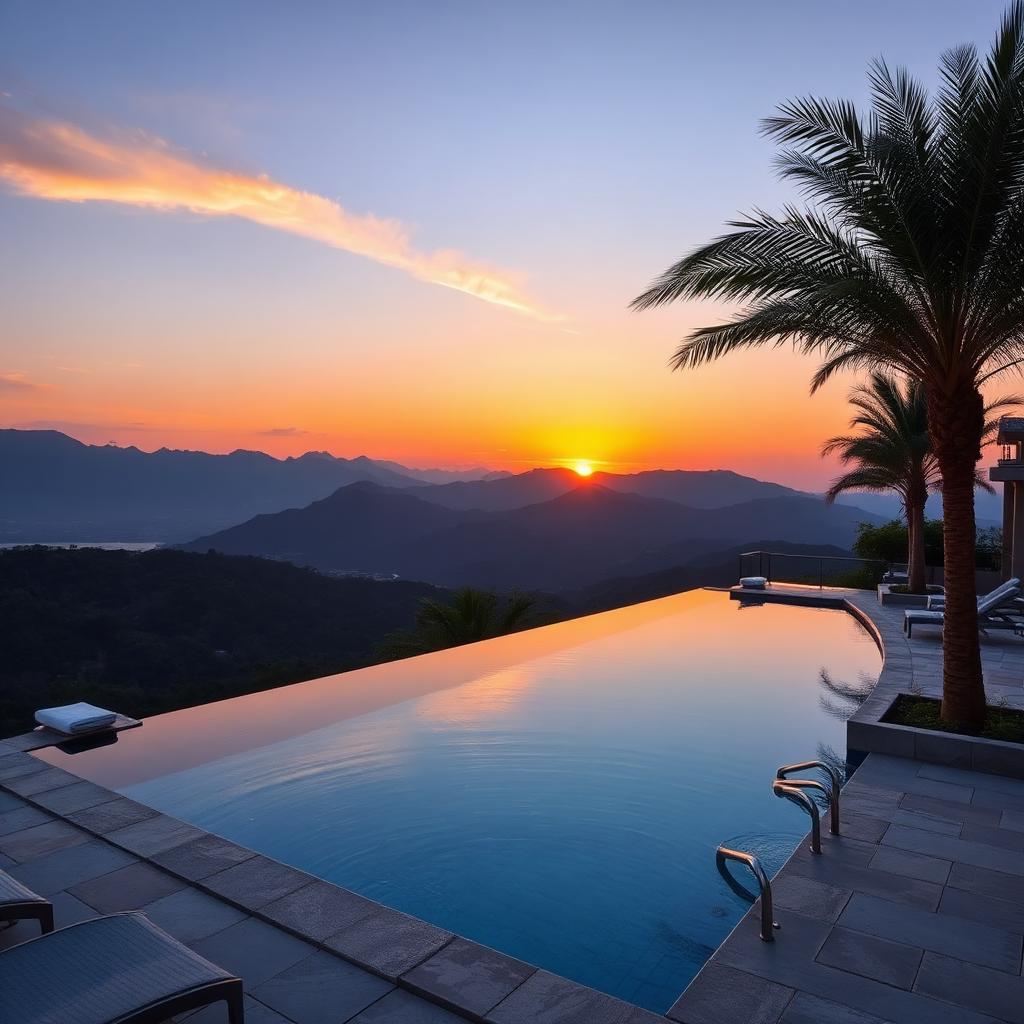
An infinity pool works on one trick: from a specific eye height, water spills over an invisible edge into a lower catch basin and appears to merge with the horizon behind it. That trick only works from that viewpoint, on the right slope, with the right water level. Get any of those wrong and you have paid a considerable premium for what looks like a normal pool.
What an infinity edge actually does
A negative or infinity edge is one side of the pool built exactly at the water line, with a hidden catch basin below. Water overflows continuously, is pumped back into the pool, and appears — from the primary viewpoint — to have no boundary.
The illusion depends entirely on the horizon behind the edge. If the eye reads a strong horizontal line beyond the water (a sea, a valley floor, a distant tree line), the pool merges into it. Without that horizon, you have an expensive overflow trough.
Where the effect works — and where it doesn't
Works: sites with a genuine downhill slope of at least 3–4 metres beyond the pool edge, an unobstructed distant view, and a fixed primary viewpoint (a terrace, dining table or interior sofa) at roughly the same height as the water.
Does not work: flat urban plots with a fence or neighbouring roof behind the edge, sites where the primary viewpoint is well above the pool (you will see the catch basin), and any site where the 'view' is a nearby tree or wall — the edge will simply disappear into it, not into infinity.
Structure and the real cost drivers
Infinity pools cost 25–40% more than a comparable rectangular pool. The premium is not in the shape — it is in the perimeter beam, the catch basin, the second circulation pump, and the ground beam anchoring the downhill side against overturning.
On sloping sites the retaining structure below the pool is often the single largest cost line, sometimes larger than the pool itself. Get a structural engineer involved before finalising the pool location, not after.
Coping, tile and interior finishes
The three infinity sides usually take standard coping. The vanishing edge itself takes a bullnose or knife-edge stone with a machined water channel — this is a specialist stone job, not a general mason's job.
Interior finish: for the strongest reflective effect and cleanest edge line, use a dark grey or midnight blue plaster or a small-format glass mosaic in a similar tone. Pale interiors read as swimming pool; dark interiors read as mirror.
Deck, planting and lighting around the edge
Keep planting away from the vanishing edge itself — the eye must travel straight from water to horizon with nothing interrupting the line. Push all planting to the other three sides.
Underwater lighting on the vanishing edge is usually wrong — it makes the water source visible at night and breaks the illusion. Light the catch basin below instead, and let the pool itself reflect the sky.
Key Takeaways
- An infinity edge needs a real horizon behind it — a fence is not a horizon.
- Primary viewpoint height must roughly match the water level.
- Budget 25–40% more than a rectangular pool, plus retaining structure on slopes.
- Dark interior finish, machined stone edge, and no perimeter planting on the vanishing side.
Frequently Asked Questions
Can I install an infinity pool on a flat plot?
Not effectively. Without a downhill slope and a distant horizon, the vanishing edge has nothing to merge into. On a flat plot a perimeter overflow or standard rectangular pool will look better and cost less.
How much does an infinity pool cost?
In 2026, expect £120,000–£350,000 in the UK and $150,000–$500,000+ in the US for a residential infinity pool with retaining works, depending on size, site and finishes.
Are infinity pools more expensive to maintain?
Slightly. The extra pump and continuous overflow use more energy and evaporate more water than a standard pool. Annual chemistry, cleaning and cover maintenance are otherwise the same.