8 Dreamy Night Garden Inspirations with Soft Lighting
Soft glowing accents, structured pathways and lush greenery combine to form dreamy outdoor environments. Eight inspirations for designing a calm, natural, visually stunning night garden.

A garden at night is a different design problem from a garden by day. The eye stops reading colour and starts reading contrast, shape and depth. Soft, warm lighting — placed deliberately, not sprinkled — is what turns an ordinary backyard into something that feels calm, intentional and quietly dramatic. These eight inspirations are the lighting moves we return to on almost every evening-garden project.
Why soft light beats bright light
Bright, cool light flattens a garden. It turns leaves grey, kills depth and makes every surface compete for attention. Warm light at low intensity does the opposite: it picks out one or two heroes, lets everything else fall into soft shadow, and gives the garden a sense of mystery you simply do not get during the day.
Aim for 2700K or warmer, dim outputs (1–3W LED is usually plenty per fixture), and always more fixtures at lower brightness than fewer fixtures cranked up. The goal is glow, not floodlight.
1. A curving, glowing pathway
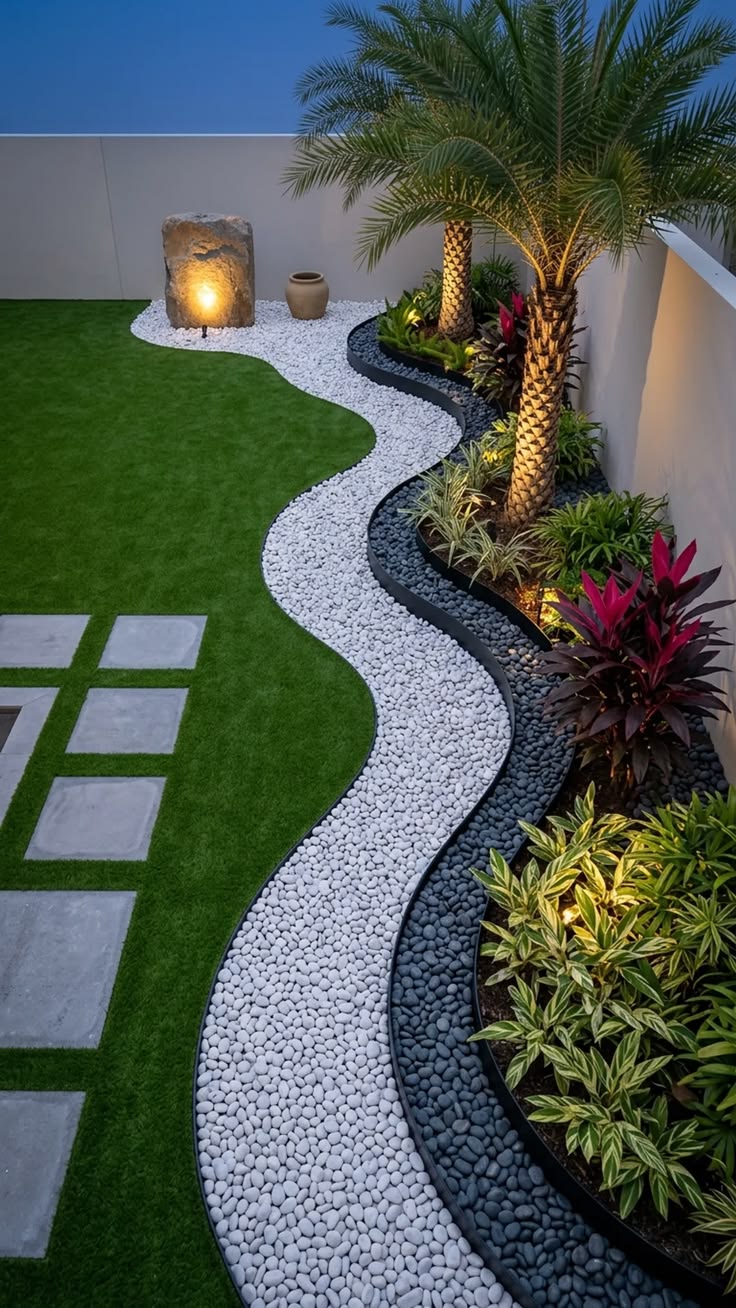
A pale gravel or pebble path catches even the smallest amount of light and returns it as a soft glow. Pair white pebbles with low spike lights tucked into the planting on either side, and the path itself becomes the brightest object in the garden after dark — drawing the eye gently from one zone to the next.
Curve the path rather than running it straight. A serpentine line creates rhythm, hides the destination, and makes the garden feel larger than it is.
2. Uplit foliage as living sculpture
Place a single warm uplight at the base of a palm, tree fern, Japanese maple or large architectural shrub and the leaves become a slow-moving sculpture overhead. Light from below — never from above — to keep the effect dreamy rather than clinical.
Hide the fixture in the planting or behind a stone so the source disappears. You should see the glow, not the bulb.
3. A single grazed feature stone
One large boulder or sculptural stone, grazed by a low warm light tucked at its base, becomes a focal point that anchors the whole garden. The texture of the stone — rough, mineral, ancient — reads beautifully under raking light.
Surround it with pale gravel to bounce a little extra light back up, and resist adding a second feature stone. One is calm; two is competition.
4. Concealed border glow
Run a continuous low-output LED strip or a line of small bullet lights under the lip of a raised border or planter edge. The light spills onto the bed, washes the foliage from below, and the fixture itself is invisible from any normal viewing angle.
This is the single move that does the most to make a garden look professionally lit rather than functionally lit.
5. Lit water for reflection
Even a shallow water bowl doubles the impact of every nearby light. Set one warm fixture so it grazes the water surface rather than pointing into it — the reflection of foliage, sky and lanterns becomes the feature, not the water itself.
A still surface reads as a mirror; a moving one reads as a shimmer. Both work; pick the one that matches the mood you want.
6. Moonlight through a tree canopy
Mount a cool-ish (3000K) downlight high in a tree and aim it through the branches. The shadows the leaves throw on the path or terrace below mimic moonlight and shift gently in any breeze.
This is the only place we use slightly cooler light — it reads as natural, not artificial, because we associate cool light with the moon.
7. A warm pool around seating
Cluster two or three small lanterns, candles or low pillar lights around the seating area to create a contained pool of warm light. Keep it lower than eye level so you never look into the source while sitting.
Combine with a single uplit plant nearby and the seating area becomes its own outdoor room, distinct from the rest of the garden.
8. Three layers of light across the garden
The most polished night gardens always have three layers: a low ground layer (path lights, step lights, border glow), a mid layer (uplit shrubs and feature stones), and an overhead layer (moonlighting from trees or a pergola).
Set each layer on its own switch or smart circuit so you can dial the garden from quiet supper to full dinner-party drama without ever touching a single bright bulb.
Key Takeaways
- Use warm light (2700K) at low output — glow, not floodlight.
- Light the centre and canopy of the garden, never the perimeter fence.
- Build the scene in three layers: ground, mid-level foliage, and overhead.
- Hide every fixture; the eye should see the effect, not the source.
- One uplit feature stone or specimen tree beats five competing focal points.
Frequently Asked Questions
What colour temperature is best for a night garden?
2700K is the safe default for foliage, paths and seating areas. Use 3000K only when you want a cooler 'moonlight' effect downlit through tree branches. Anything above 3500K outdoors tends to look harsh and commercial.
Are solar lights bright enough for a designed night garden?
For accent path markers and gentle border glow, modern solar lights are fine. For uplighting trees, grazing stones or any feature you want to be the hero of a view, use low-voltage 12V LED — output and beam control are far better, and the fixtures are far smaller.
How many lights do I need for a small garden?
In a 30–50m² garden we typically use six to ten low-output fixtures: two or three uplights on key plants or a feature stone, one or two path lights, one downlight in a tree if you have one, and concealed border glow along the main bed.