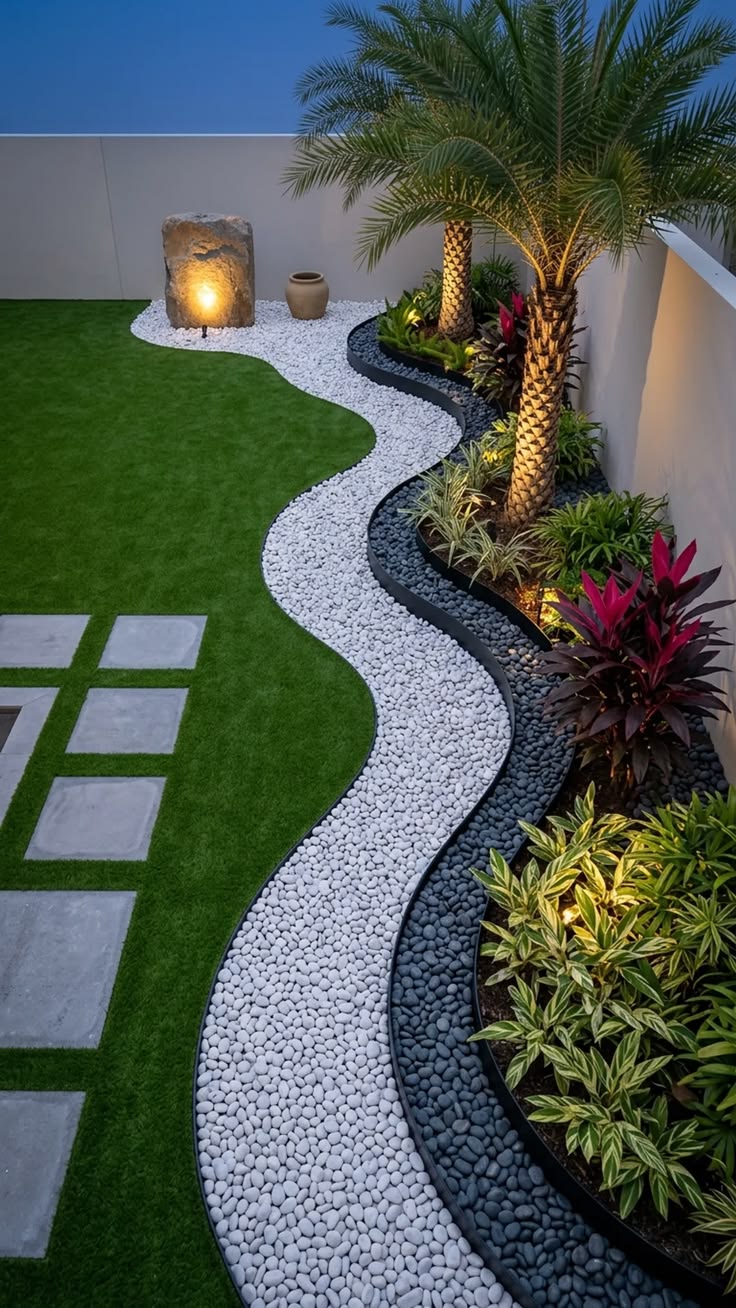
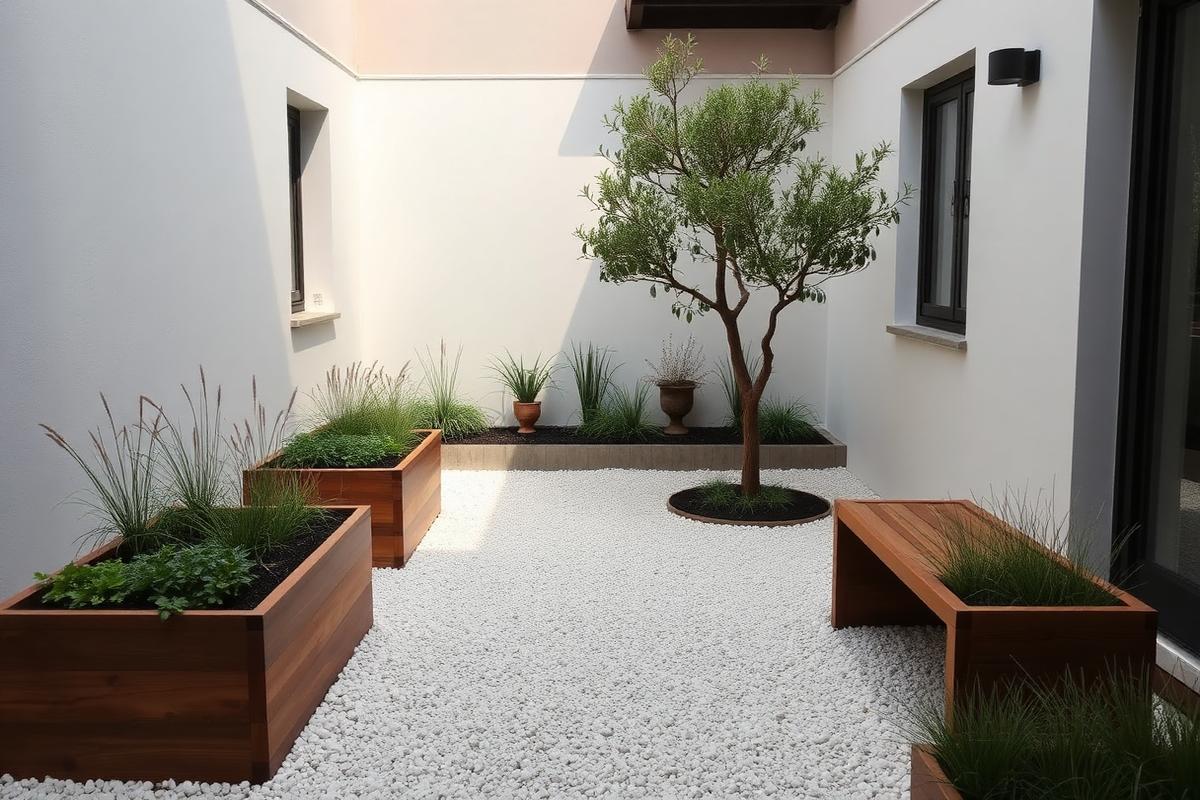
4 Modern Courtyard Night Lighting Showcases
Four built modern courtyards photographed at dusk, each demonstrating a different way to combine soft warm lighting, structured stonework and lush planting.

Rather than a how-to, this piece is a visual reference. Four modern courtyards, all photographed in the same blue hour between sunset and full night, each handling soft lighting in a slightly different way. Use them as a mood board for your own scheme — what to copy, what to adapt, and what to leave alone.
1. Pergola lounge with a lit waterfall niche
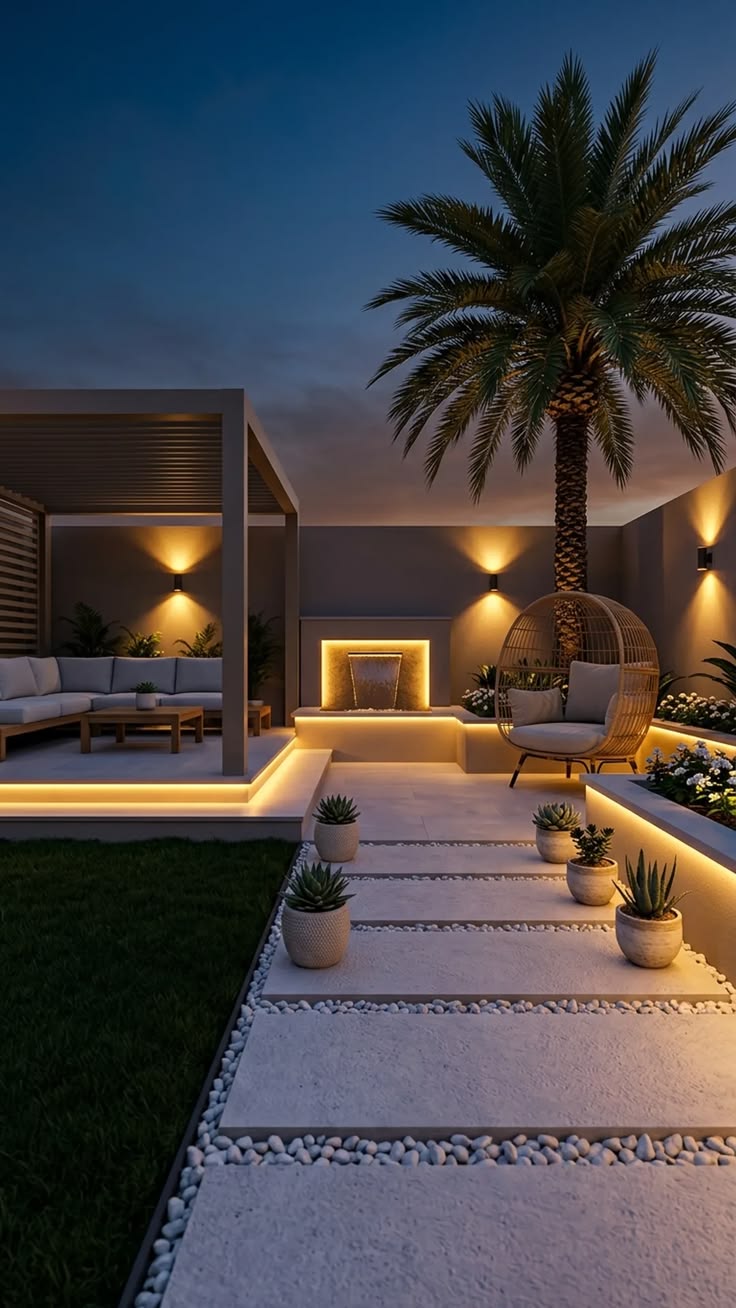
A deep grey pergola anchors the left of the composition, with a built-in L-sofa tucked underneath and warm wall washers picking out the perimeter wall in soft scallops of light. The hero detail is the recessed waterfall niche between the pergola and the egg chair: a single warm fixture grazes the sheet of water and turns it into the brightest point in the scene.
The pebble-edged stepping-stone path doubles the lighting effect — the pale stones bounce a little extra glow back up into the succulents in concrete pots. Note how every fixture is hidden; you only ever see the light, never the source.
2. Twin water walls under a flat pergola
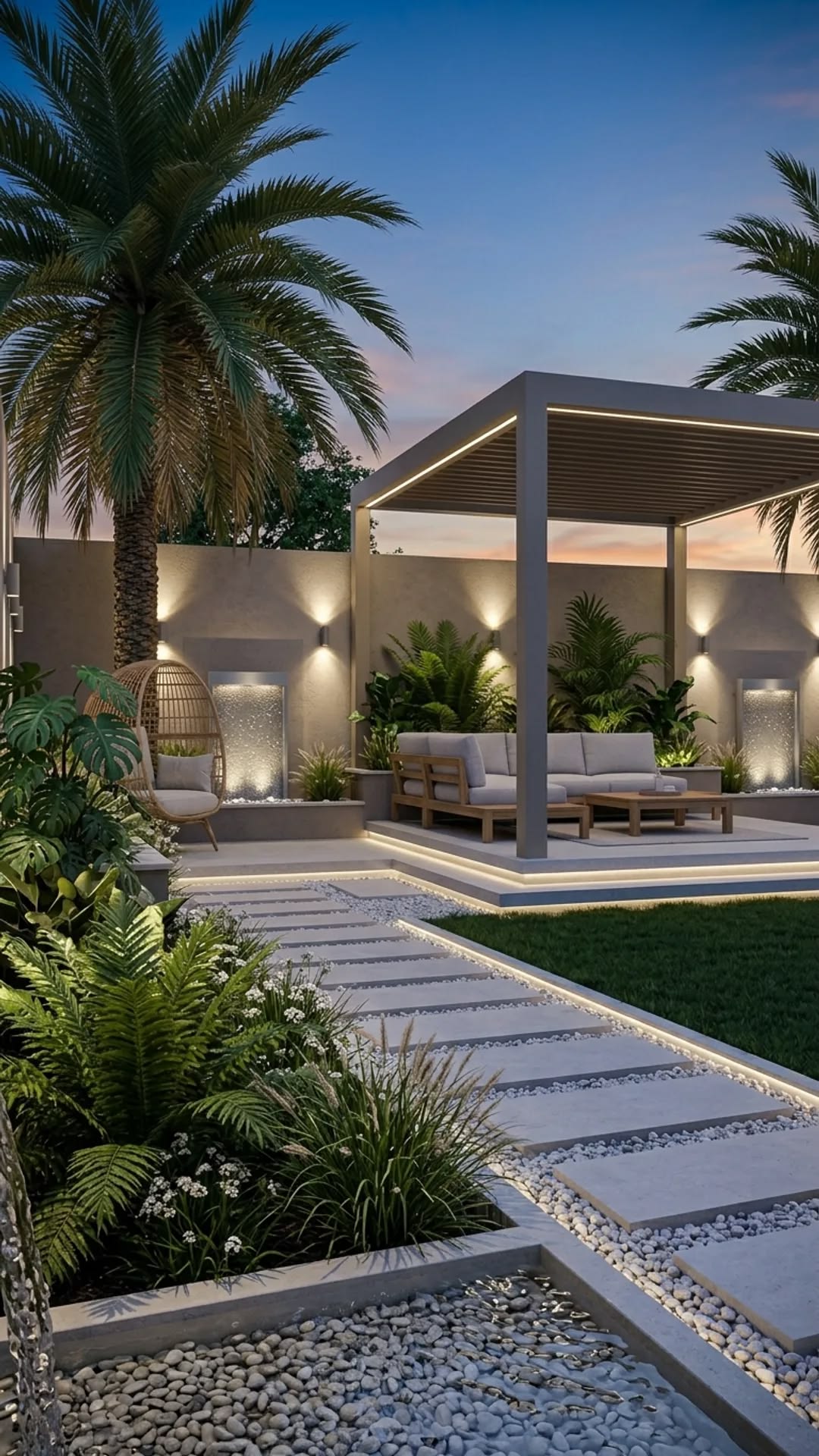
Here the same vocabulary — flat pergola, grey stucco walls, warm scalloped wall lights — is rearranged around two symmetrical water walls flanking the seating platform. The symmetry reads as calm rather than rigid because the planting on either side is deliberately asymmetric: a tall date palm on the left, a softer cluster of ferns and ornamental grasses on the right.
The stepping-stone path is the same idea as showcase 1, but stretched into a longer linear run with crisp pebble joints. This is a good reference for a narrow side-return where you need the path to do most of the design work.
3. Aerial geometry: lawn, pebbles and pavers
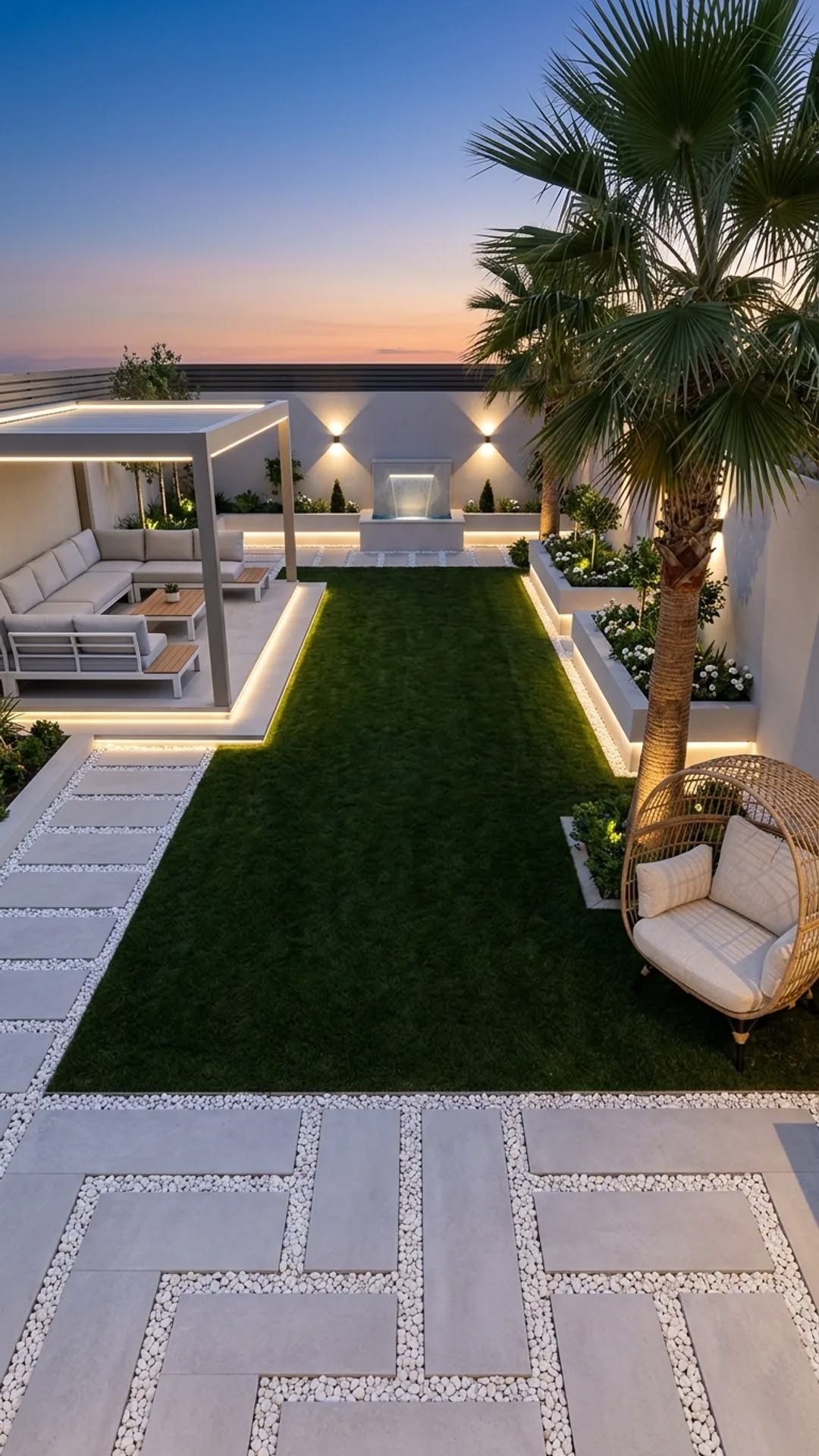
Seen from above, the same design language becomes a study in geometry. A central rectangle of lawn is framed by raised white planters with concealed LED strips under their lips, and a single lit water blade on the back wall closes the axis. In the foreground, large square pavers and white pebbles are interlocked into a basketweave pattern that reads beautifully under low light.
This is the showcase to study if you have a generous, regular plot. Every line is intentional, every material reappears in at least two places, and the lighting simply traces the geometry that the hard landscaping has already drawn.
4. Linear sconces and a bollard-lit path
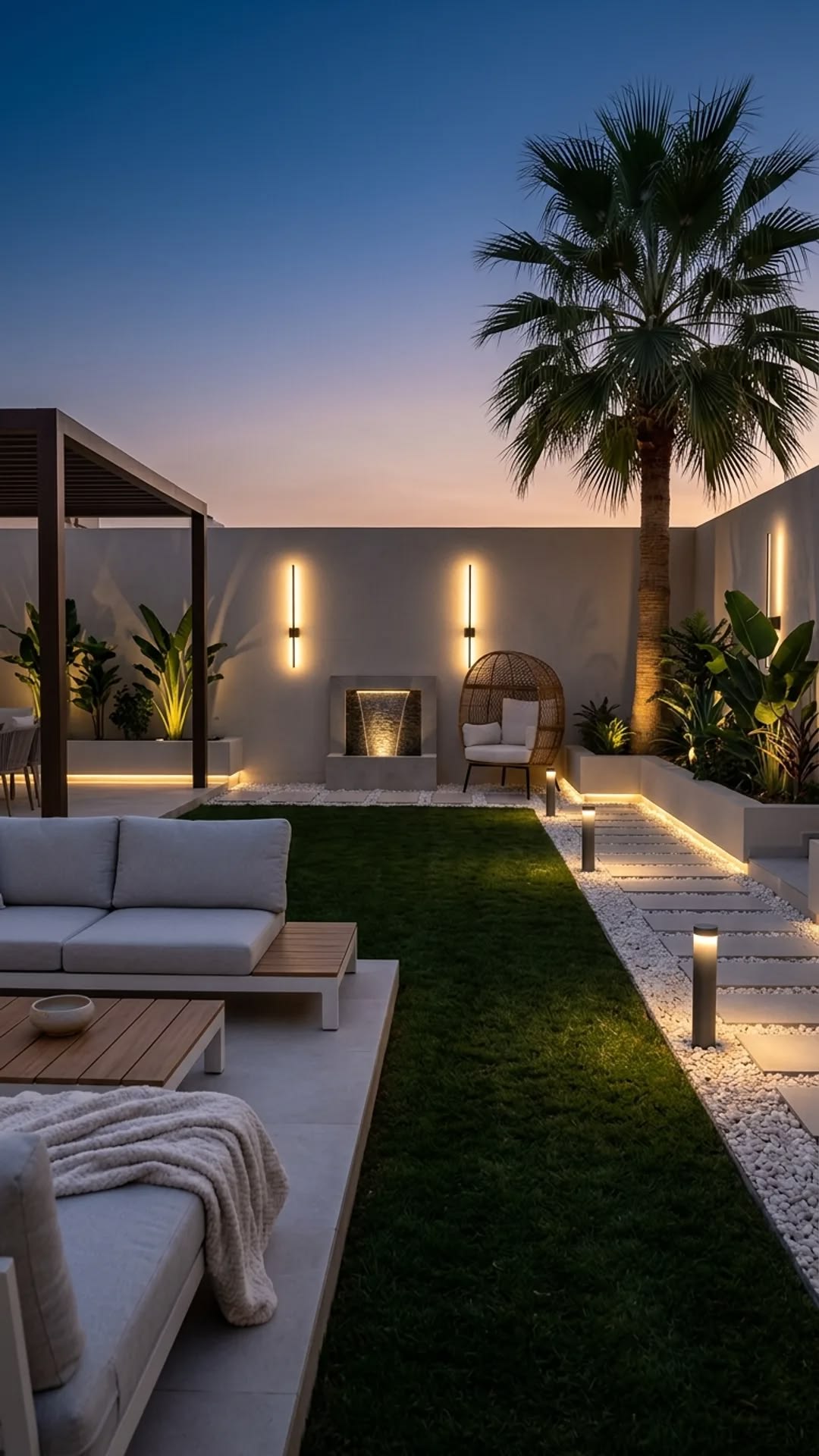
The fourth courtyard swaps scalloped wall washers for two tall linear sconces — long vertical bars of warm light that read almost as architecture. A small wall-mounted water feature sits between them, and a wicker egg chair fills the corner under the palm.
The right-hand path is the most instructive detail: rectangular pavers set into white pebbles, with low bollard lights spaced evenly along one edge. Bollards work here because the path runs against a planted bed; in the middle of a lawn they would feel exposed.
Common threads across the four
Despite the different layouts, the four courtyards share a tight material palette: pale stucco walls, grey porcelain pavers, white pebbles, teak or rattan furniture, and a single statement palm. The lighting palette is just as tight — warm white only (around 2700K), always concealed, always layered between wall, water and ground.
If you take one thing from this showcase, take that restraint. Every one of these schemes could have been busier; none of them are. That is what makes them feel resolved at night.
Key Takeaways
- Hold a tight material palette: stucco, pale pavers, white pebbles, one statement palm.
- Stick to one colour temperature (2700K warm white) across every fixture.
- Use water as a light multiplier — even a small lit niche becomes the hero.
- Pebble joints between pavers bounce extra glow and break up large stone areas.
- Hide every source; the eye should see the effect, not the fixture.
Frequently Asked Questions
Can these schemes work in a small backyard?
Yes — showcase 1 and showcase 4 are essentially compact courtyard layouts and translate directly to a 25–40m² backyard. Keep the material palette tight and use a single pergola or water feature as the focal point.
What palms are used in these courtyards?
The schemes shown use date palms (Phoenix) and fan palms (Washingtonia). In colder climates, swap for a hardy windmill palm (Trachycarpus fortunei) or a multi-stem olive for a similar silhouette.
Are the LED strips under the planters waterproof?
For outdoor use you want IP65 or higher for strips tucked under planter lips, and IP67 for anything that could sit in standing water. Always pair with a low-voltage 12/24V driver rated for outdoor use.